Chicago, IL
20 May 2007
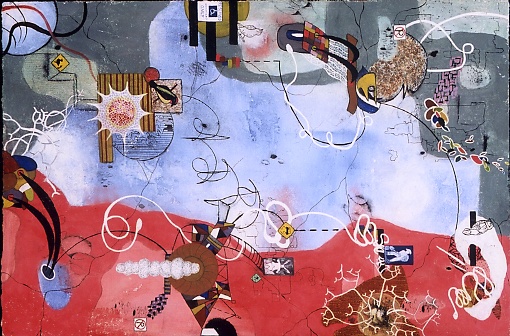
The unwieldy plaster ground of Judith Mullen’s frescoes makes it impractical to use them for the poetic purpose that seems embedded in them: to serve as maps for getting lost and found and then lost again. An entire history of non-objective modernist painting—from Kandinsky through Miro and Matta and on to late Bontecou—is recalled through Mullen’s idiosyncratic forms, wispy looping lines, colorful yet earthy pigments, and dancing all-over compositions, but somewhere along the way these frescoes took a meandering turn through Situationism. And there begins their map-like quality, for how else to understand the occasional depiction of a “no parking” or “men at work” sign? Suddenly those abstract marks morph into roads and routes, the view turns aerial, and one not only wonders but wanders across the stained and painted surface.
—Lori Waxman